
What Does BMRDA Approved Really Mean for Your Plot Purchase?
If you have spent any time browsing residential plots in Bengaluru, you have seen the term "BMRDA Approved" stamped across brochures, hoardings, and listing portals.
For many buyers, it acts as a general seal of credibility. But what does BMRDA approval actually guarantee? Does a BMRDA sanction protect your property from demolition, ensure bank loan eligibility, or guarantee that roads and parks will be developed as promised?
Understanding the precise legal and planning authority behind your plot is the difference between owning a legally secure, appreciating asset and being stuck with an unsanctioned layout.
This guide explains what BMRDA approval covers, how local planning authorities function under the BMRDA umbrella, and the step-by-step verification process you must follow before signing an agreement.
Key Takeaways
- Planning Authority Role: The Bangalore Metropolitan Region Development Authority (BMRDA) is the apex planning body governing the urban and peri-urban growth regions surrounding BBMP and BDA limits.
- Local Planning Authorities (LPAs): BMRDA operates through local statutory authorities—including the Malur Planning Authority (MPA), Hoskote Planning Authority (HPA), and BIAAPA (Devanahalli)—which evaluate and sanction specific layout plans.
- Legal Safeguards: A legitimate BMRDA/LPA sanction guarantees that mandatory road widths (minimum 30–40 ft), park spaces, and civic amenity (CA) plots have been officially relinquished to the government, preventing unlawful future encroachment or redevelopment.
- Bank Loan & Khata Link: Nationalized and leading private banks finance only those plotted developments that have valid BMRDA/LPA sanctions, DC conversion, and e-Swathu E-Khata or A-Khata documentation.
What Is BMRDA and How Does It Operate?
The Bangalore Metropolitan Region Development Authority (BMRDA) was established under the BMRDA Act, 1985, to coordinate the rapid urban growth of the Bengaluru Metropolitan Region (encompassing Bengaluru Urban, Bengaluru Rural, and adjoining planning belts).
While the BDA (Bangalore Development Authority) plans within the core municipal corporation zones, the BMRDA plans the outer growth corridors where most new plotted communities are built.
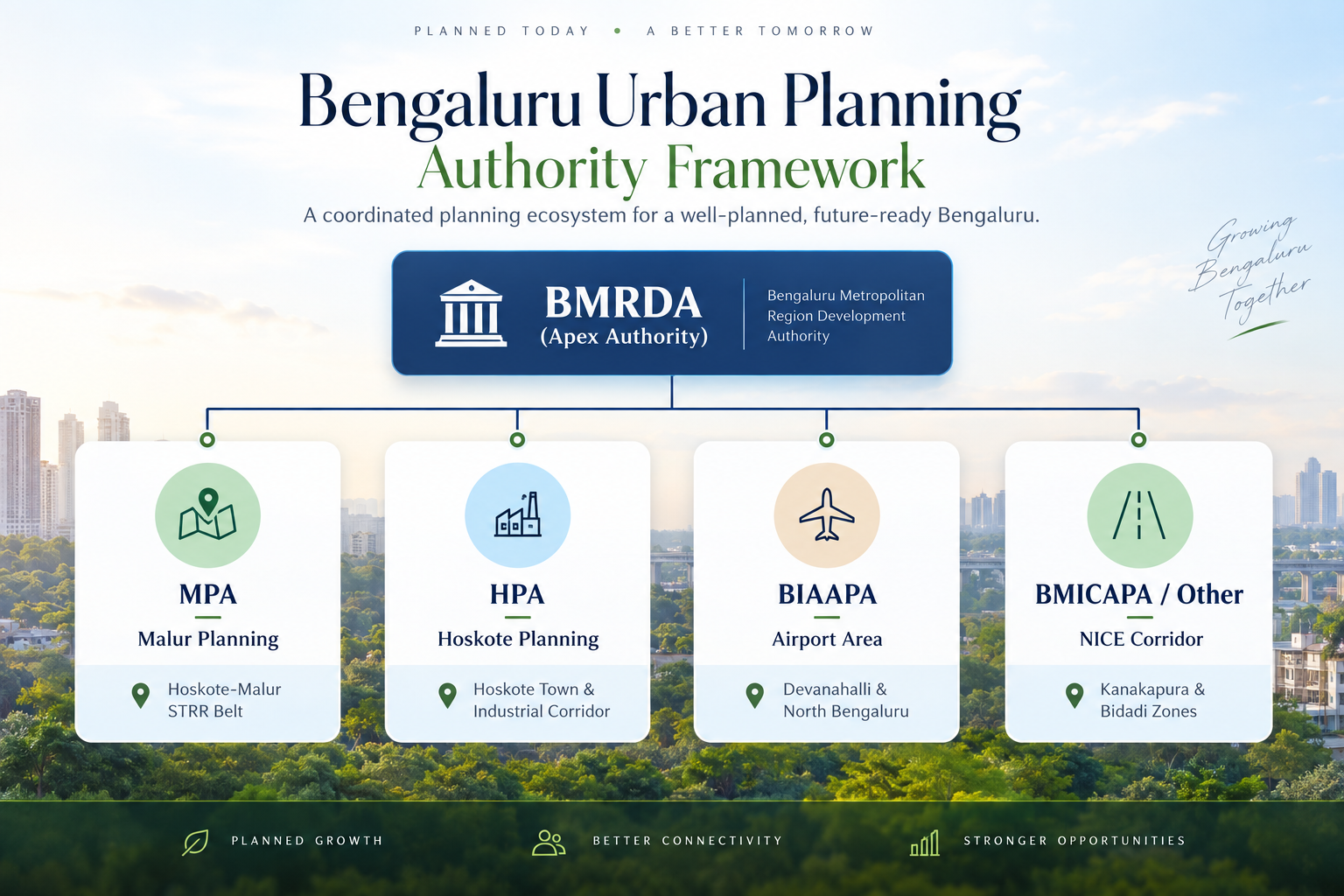
Figure 1: Statutory planning authorities operating under the BMRDA regional framework.
Local Planning Authorities (LPAs) Under BMRDA
BMRDA delegates localized zoning, master planning, and layout sanctions to dedicated Local Planning Authorities (LPAs):
- MPA (Malur Planning Authority): Governs plotted developments in the Malur-Hoskote fringe and STRR industrial corridor.
- HPA (Hoskote Planning Authority): Governs layouts in and around Hoskote town.
- BIAAPA (Bangalore International Airport Area Planning Authority): Covers Devanahalli and the northern aerospace corridor.
- Anekal Planning Authority (APA): Manages southern growth sectors near Electronic City and Attibele.
When a developer states that their layout is "BMRDA approved," they are typically referring to a layout sanctioned by the specific LPA operating under BMRDA jurisdiction for that taluk.
The 4 Non-Negotiable Standards of a BMRDA/LPA Approved Layout
A layout cannot obtain BMRDA or LPA sanction merely by paying an application fee. The developer must satisfy strict urban planning bylaws:
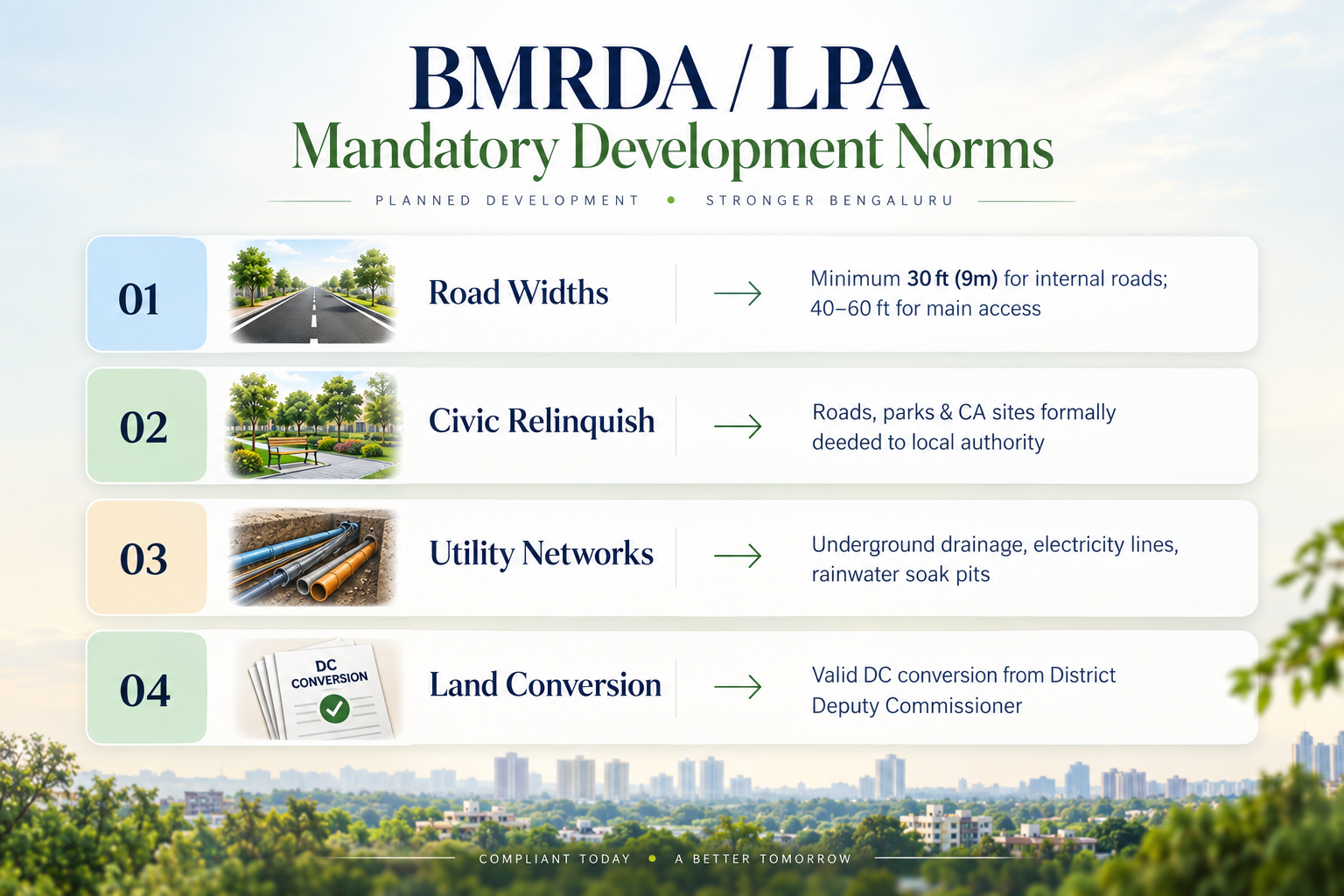
1. Mandatory Road Widths
Unapproved layouts often cut internal roads down to 20 or 25 feet to maximize sellable area. Under BMRDA regulations, internal layout roads must be at least 9 meters (30 feet) wide, with arterial roads spanning 40 to 60 feet to ensure adequate fire engine and utility access.
2. Mandatory Relinquishment of Public Spaces
In a sanctioned layout, approximately 45% to 50% of the gross land area is dedicated to roads, open green parks, and Civic Amenity (CA) sites. The developer must execute a registered Relinquishment Deed transferring these areas to the local authority, ensuring they can never be built upon or sold to private buyers.
3. Underground Drainage (UGD) and Utilities
BMRDA guidelines mandate proper civic infrastructure: underground sewage lines, storm-water drains, street illumination, and connections to dedicated soak pits or treatment facilities.
4. Direct Link to DC Conversion
BMRDA will not review a layout plan unless the land has already undergone formal Deputy Commissioner (DC) Conversion from agricultural use to residential use under Section 95 of the Karnataka Land Revenue Act.
For an overview of how layout infrastructure directly impacts livability, read our corridor review: Plots for Sale in Hoskote → Legal & Infrastructure Guide
BMRDA Sanction vs Unapproved Revenue Plots: A Clear Comparison
Understanding the structural differences between an approved layout and an unauthorized revenue site protects you from costly legal disputes.
4-Step Checklist: How to Verify a BMRDA Sanctioned Plot
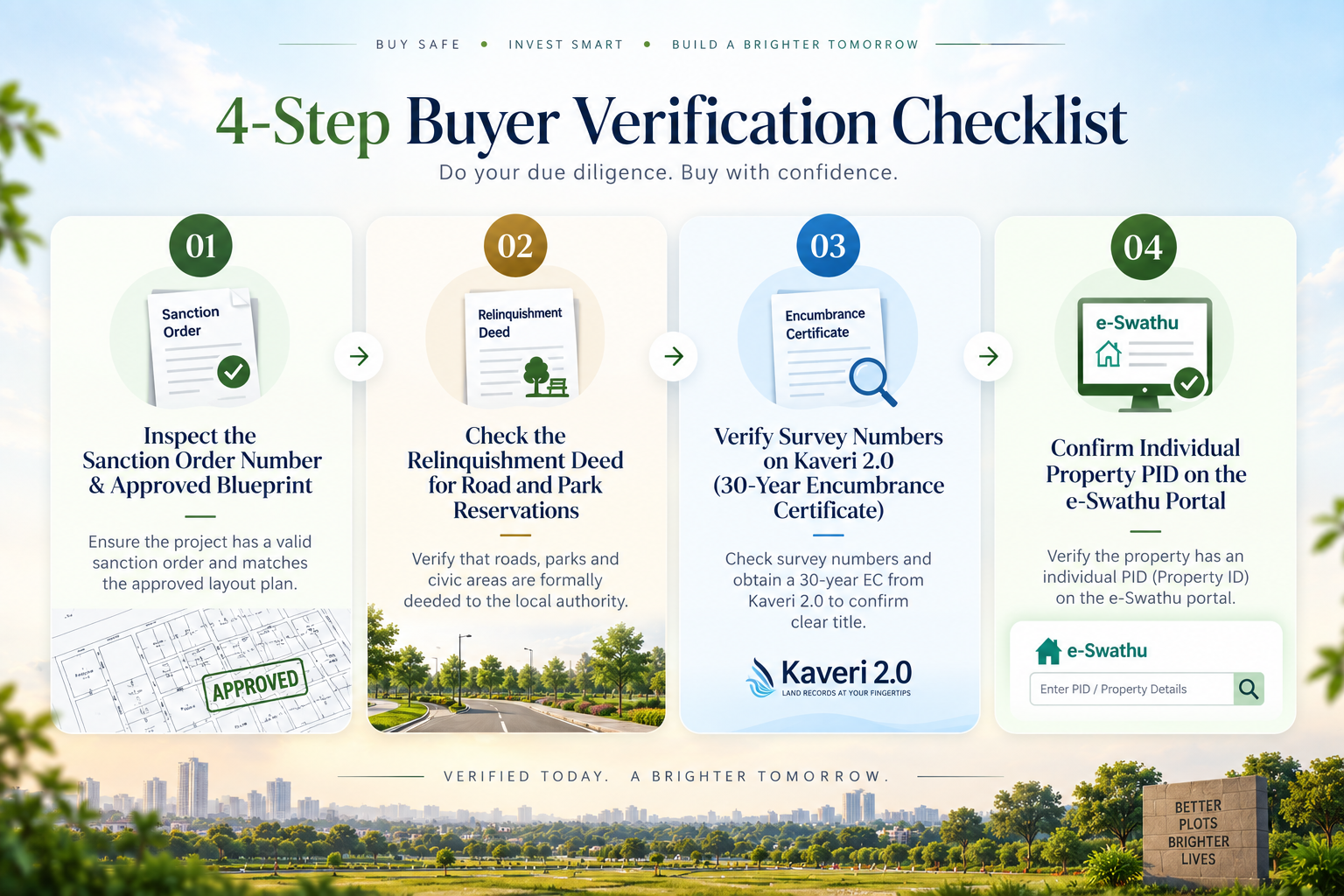
Before making a financial commitment, conduct this 4-step verification:
Step 1: Request the Sanction Order & Approved Blueprint
Ask the developer for a copy of the Official Sanction Order (Prakatane) and the approved blueprint signed and sealed by the Town Planning Member of the respective Planning Authority (e.g., Member Secretary, MPA). Verify that your specific plot number appears on the sanctioned drawing.
Step 2: Check the Registered Relinquishment Deed
Confirm that the roads, parks, and civic amenities shown on the map have been formally handed over to the local planning authority via a registered deed.
Step 3: Check Title & Survey Numbers on Kaveri 2.0
Obtain an updated 30-year Encumbrance Certificate (Form 15) using the Karnataka Sub-Registrar's Kaveri 2.0 portal. Verify that the survey numbers listed on the BMRDA sanction order match the title deed without any mortgage or court litigation entries.
Step 4: Verify Digital Khata on e-Swathu
Ensure the plot has an assigned Property Identification Number (PID) on the Karnataka Government's e-Swathu portal (Form 9 and Form 11B). Avoid layouts where the developer promises a "Khata after full payment" without showing digital entry proof.
For a detailed guide on checking regional connectivity in East Bengaluru, see: Plots for Sale in Hoskote, Bangalore: Everything a Buyer Should Know in 2026
Featured Development: Aloka Green County (MPA Approved)
If you are looking for an approved, ready-to-build residential plot in the East Bengaluru growth corridor, explore Aloka Green County.
Located in Malur, Arasanahalli—just 3 km from the STRR and 15 minutes from Hoskote Town—Aloka Green County is fully sanctioned by the Malur Planning Authority (MPA) under the BMRDA regional framework.
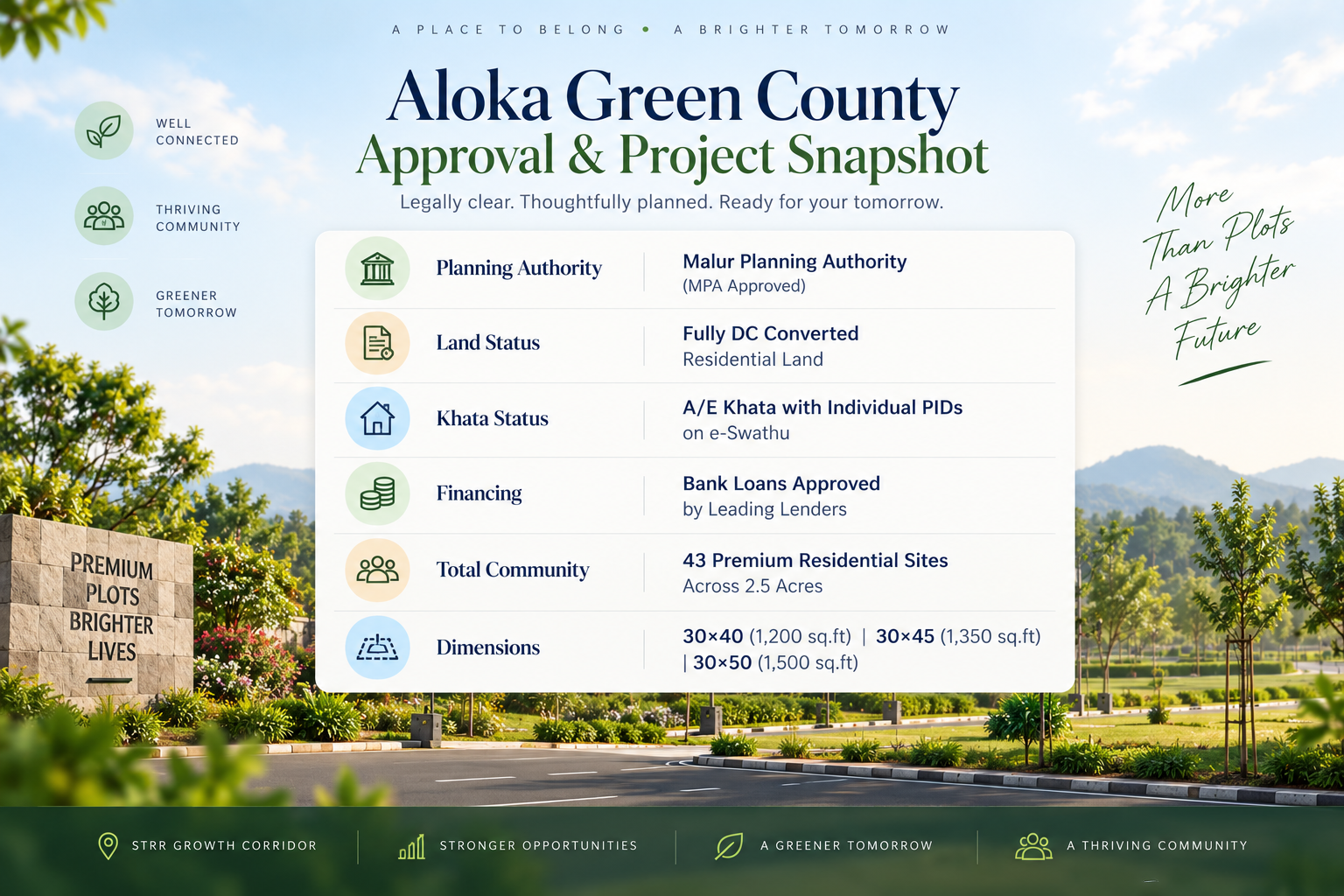
Completed On-Ground Infrastructure
- 9-meter wide asphalt internal roads with paver-block pedestrian borders
- Fully executed Underground Drainage (UGD) and rainwater harvesting soak pits
- Dedicated electricity lines and LED street lighting
- Piped water supply infrastructure with overhead storage support
- Perimeter security compound wall, entrance arch, and 24×7 CCTV monitoring
- Children's play zone and landscaped park areas
Frequently Asked Questions
1. Does BMRDA approve layouts directly or through local planning authorities?
BMRDA acts as the overarching regional planning authority. Specific layout sanctions in peripheral taluks are evaluated and approved by designated Local Planning Authorities (LPAs) such as the Malur Planning Authority (MPA), Hoskote Planning Authority (HPA), and BIAAPA.
2. Can I get a home construction loan for a BMRDA/MPA approved plot?
Yes. Nationalized banks (such as SBI and Canara Bank) and premier housing finance companies (HDFC, ICICI, LIC HFL) routinely approve plot purchase and home construction loans for properties with valid planning authority sanctions, DC conversion, and e-Swathu Khatas.
3. What is the difference between BDA and BMRDA approval?
BDA governs areas falling within Bengaluru's municipal corporation boundaries (BBMP zones). BMRDA and its constituent LPAs govern the broader metropolitan region outside BDA limits, including key growth corridors along the STRR, Hoskote, Malur, and Devanahalli.
4. Can a Gram Panchayat approve a residential layout without BMRDA/LPA sanction?
No. Gram Panchayats do not have the statutory authority to convert agricultural land or sanction layout master plans under the Karnataka Town and Country Planning Act. Layouts that hold only Gram Panchayat permissions without planning authority sanction are considered unauthorized revenue layouts.
Conclusion: Prioritize Proof Over Promises
A residential plot is a long-term foundation for your family's future. Investing in a property with clear BMRDA / LPA sanction, DC conversion, and e-Swathu Khata ensures that your title is clear, your layout infrastructure is guaranteed, and your investment remains safe from regulatory disputes.
Always demand to inspect the original sanction documents, verify the survey numbers, and choose a developer that provides complete transparency.
Verify Sanction Documents in Person at Aloka Green County
Inspect our original MPA sanction order, DC conversion certificates, and completed on-ground road and drainage development.
👉 Book a Free Site Visit with Aloka Developers or contact our property specialists directly:
- 📞 Phone: +91 91879 69708 / +91 91879 69709
- ✉️ Email: info@alokadevelopers.com
- 📍 Office: No. 6, Sy. No. 2 & 3, Kammasandra Village, Bidarahalli Hobli, Bengaluru - 560049